 midas media.

Most contractors still think local SEO ends with rankings, reviews, and a decent Google Business Profile. That's no longer enough. As AI search tools start answering homeowner questions directly, the real game is whether your business gets mentioned, summarized, and trusted inside those answers. That shift is what SEO ranking for AI (GEO) is really about. For roofing, HVAC, plumbing, solar, remodeling, and other high-ticket home service brands, GEO isn't some future trend. It's already shaping who gets the first call, and who gets skipped before a homeowner ever visits a website.
What SEO Ranking For AI (GEO) Actually Means For Local Service Businesses

SEO ranking for AI (sometimes called GEO, or generative engine optimization) is the process of making our business easy for AI systems to understand, trust, and cite when homeowners ask questions like "Who's the best roofer near me?" or "What HVAC company handles full system replacement in Lehi?"
Traditional SEO was mostly about where we ranked on a results page. GEO adds another layer: whether AI can confidently pull our company into its answer. That means our digital footprint has to be consistent across our website, Google Business Profile, reviews, service pages, citations, and third-party trust signals.
For local service businesses, this matters because AI search often compresses the decision window. Instead of clicking ten websites, a homeowner may ask one question and get three names. If we're not one of them, rankings alone won't save us.
Why Traditional Local SEO Alone Is No Longer Enough
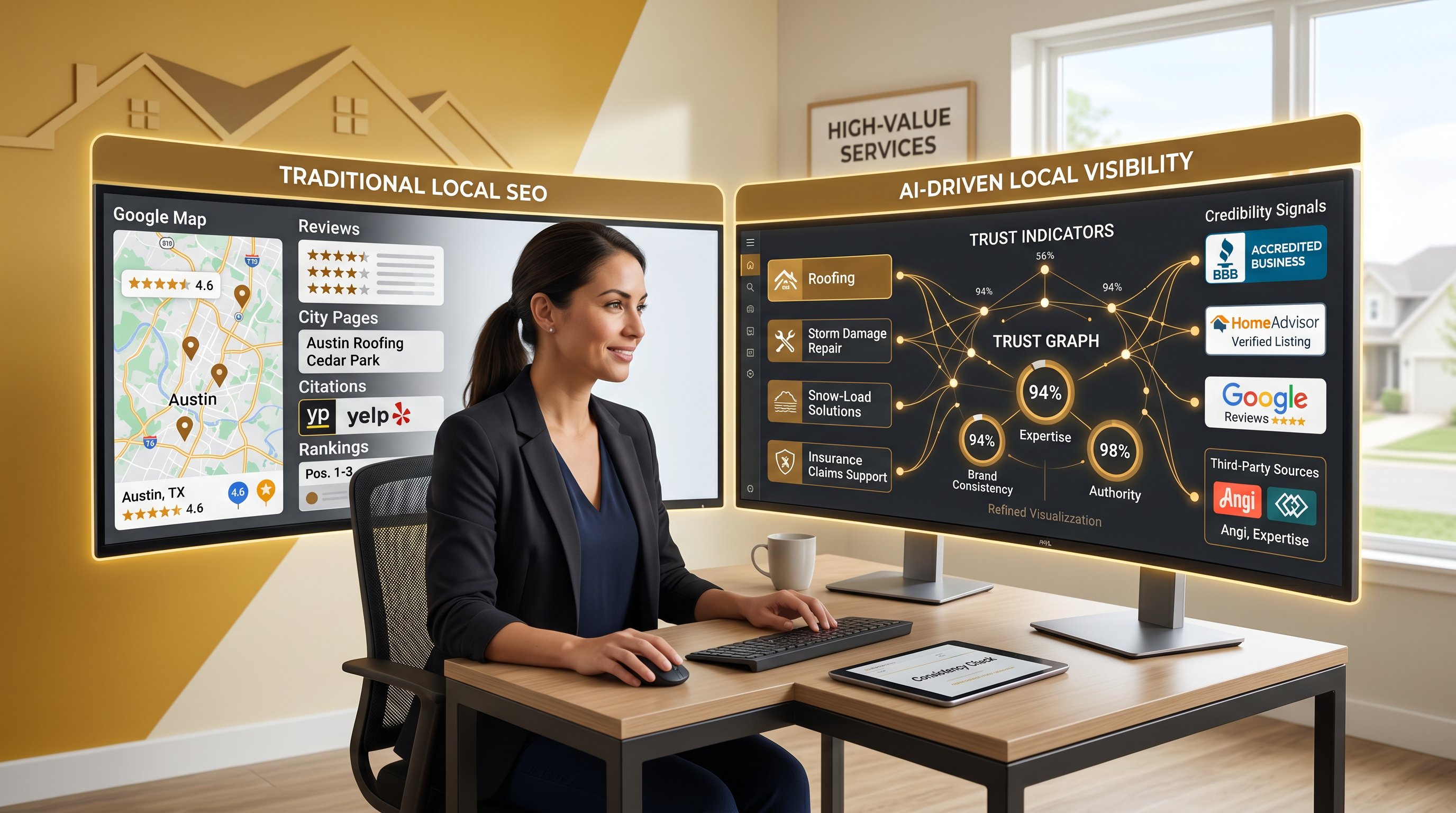
Local SEO still matters. Map pack visibility, reviews, on-page optimization, and city pages are foundational. But AI systems don't think like old-school search engines. They synthesize. They compare. They look for corroboration.
A contractor can rank reasonably well and still get ignored by AI if the brand footprint is thin, inconsistent, or vague. For example, if our site says we do "roofing services," but reviews, citations, and project content don't reinforce storm damage repair, snow-load solutions, or insurance claims help, AI has less confidence in what we actually specialize in.
That's especially important in high-ticket categories where trust drives the sale. Homeowners often validate businesses through third-party sources such as the BBB and marketplace-style directories like Angi. AI systems pick up on those off-site trust cues too.
So yes, traditional local SEO gets us in the game. GEO helps us become the answer.
The Core Signals AI Search Systems Use To Choose Which Businesses To Mention
AI search systems typically favor businesses with strong entity clarity. In plain English, they want to know exactly who we are, what we do, where we do it, and why we're credible.
The main signals include:
- Consistent business identity: name, address, phone, service categories, and coverage areas aligned everywhere
- Topical depth: pages and media that prove real expertise in roofing, HVAC replacement, repiping, panel upgrades, or basement finishing
- Third-party validation: reviews, citations, accreditations, and licensing signals
- Local proof: neighborhoods served, project examples, and issue-specific content tied to climate or housing stock
- User experience and conversions: fast mobile pages, clear calls to action, and strong engagement signals
For contractors, licensing and legitimacy matter more than many realize. Organizations like the National Association of State Contractors Licensing Agencies reinforce how central licensing standards are in this industry. AI systems tend to prefer businesses that look established, verifiable, and specific, not generic.
How Contractors Can Build Entity Authority Across Their Service Areas
Entity authority grows when every important platform tells the same story about our brand. We want AI to associate our company with specific services, locations, and outcomes.
That starts with tightly built service-area pages. Not fluff pages with swapped city names, but genuinely local pages for places like Lehi, Sandy, Draper, Provo, or Park City that reflect actual homeowner concerns. A roofer in Park City should talk about snow loads, ice dams, and canyon winds. A remodeler in Sugar House should address older homes, permits, and restoration detail.
This is where hyper-local strategy becomes a real advantage. At Midas Media, our contractor marketing approach is built around owning one market deeply instead of spreading attention thin. That aligns with how GEO works: stronger local relevance beats generic regional coverage.
And consistency matters. The same service specialties, proof points, and geography should appear across profiles, citations, videos, and reviews.
Content Strategies That Help Roofing, HVAC, Plumbing, And Remodeling Brands Surface In AI Answers
The best GEO content answers real homeowner questions before they ask for an estimate. AI tools love content that is specific, comparative, and grounded in experience.
For roofers, that may mean pages on wind-rated shingles, storm damage repair timelines, or whether heat cables make sense in heavy snow zones. For HVAC companies, content around repair-versus-replace decisions, system sizing, and high-efficiency upgrades tends to perform well. Plumbers should cover repipes, sewer issues, water quality, and emergency scenarios. Remodelers can win with cost ranges, permit guidance, and material comparisons.
Project-based content helps too. Before-and-after galleries, short job recaps, and video walk-throughs create the kind of detail AI can summarize. Broader housing-market context also supports authority. Research from the Harvard Joint Center for Housing Studies continues to show the scale of spending and demand in home improvement, which is exactly why credibility-heavy content matters in these categories.
One more thing: write for the actual sale, not just the click.
Technical And Conversion Elements That Support GEO Performance
GEO isn't only content and citations. Technical structure plays a big role in whether AI systems can parse and trust our site.
We should have clean page architecture, schema markup for local business and services, fast mobile performance, crawlable internal links, and clear contact information sitewide. FAQs help. So do service pages with structured headings that answer narrow intent.
Conversion elements matter because they reflect business quality. If traffic lands and nobody calls, books, or engages, that's a weak signal. For contractors, speed to lead is huge. Instant SMS follow-up, short quote forms, and online scheduling reduce drop-off, especially with digital-first homeowners who expect quick responses.
This is also where a serious lead-gen system separates itself from vanity SEO. Our team at Midas Media builds around exclusive territories, fast response systems, and booked-estimate outcomes. That kind of operational alignment supports stronger GEO performance because it turns visibility into proof, reviews, and brand mentions.
Conclusion
SEO ranking for AI (GEO) is really about becoming the most trustworthy local answer, not just another listing. For high-ticket contractors, that means stronger entity authority, deeper local proof, better content, and faster conversion systems. The businesses that win over the next few years won't just rank. They'll be the companies AI is confident enough to recommend by name.