 midas media.

Most contractors along the Wasatch Front don't need "more marketing." They need more of the right jobs: roof replacements after canyon winds, HVAC installs instead of low-ticket tune-ups, repipes instead of clogged-drain calls, and high-end remodeling leads that can actually turn into profitable projects. That's where the right marketing agency matters. In 2026, the gap between agencies that generate vanity metrics and agencies that produce booked estimates is getting wider. We'll break down what a contractor-focused agency should actually do, why generalists often miss the mark in Utah, and how to evaluate lead quality, territory strategy, and ROI before signing anything. And if you're losing jobs because you miss the initial call, grab this free missed call back automation guide to fix it instantly.
What A Marketing Agency Does For High-Ticket Home Service Contractors
A real marketing agency for contractors should do more than launch ads and send a monthly report. It should build a predictable lead-generation system around how Utah homeowners actually buy high-ticket services.
For roofers, that may mean dominating local search right after high winds hit Centerville or heavy lake-effect snow damages shingles in Davis County. For HVAC companies, it means capturing urgent replacement demand the moment a system fails during a brutal Salt Lake inversion or scorching summer week. For plumbers, it means filtering toward emergency work and high-value repiping jobs caused by hard water in Lehi and Draper, not just cheap service calls.
At the high-ticket level, marketing has to connect three things: intent, geography, and speed. The agency should know which Wasatch Front zip codes matter, which services have the best margin, and how to help you respond fast enough to turn inquiries into booked estimates.
In practice, that includes local SEO, paid ads, landing pages, call tracking, form routing, automation, and follow-up systems. The goal isn't "traffic." It's qualified leads that fit your service area, budget, and ideal job type.
Why Generalist Agencies Often Underperform In Roofing, HVAC, Plumbing, And Remodeling
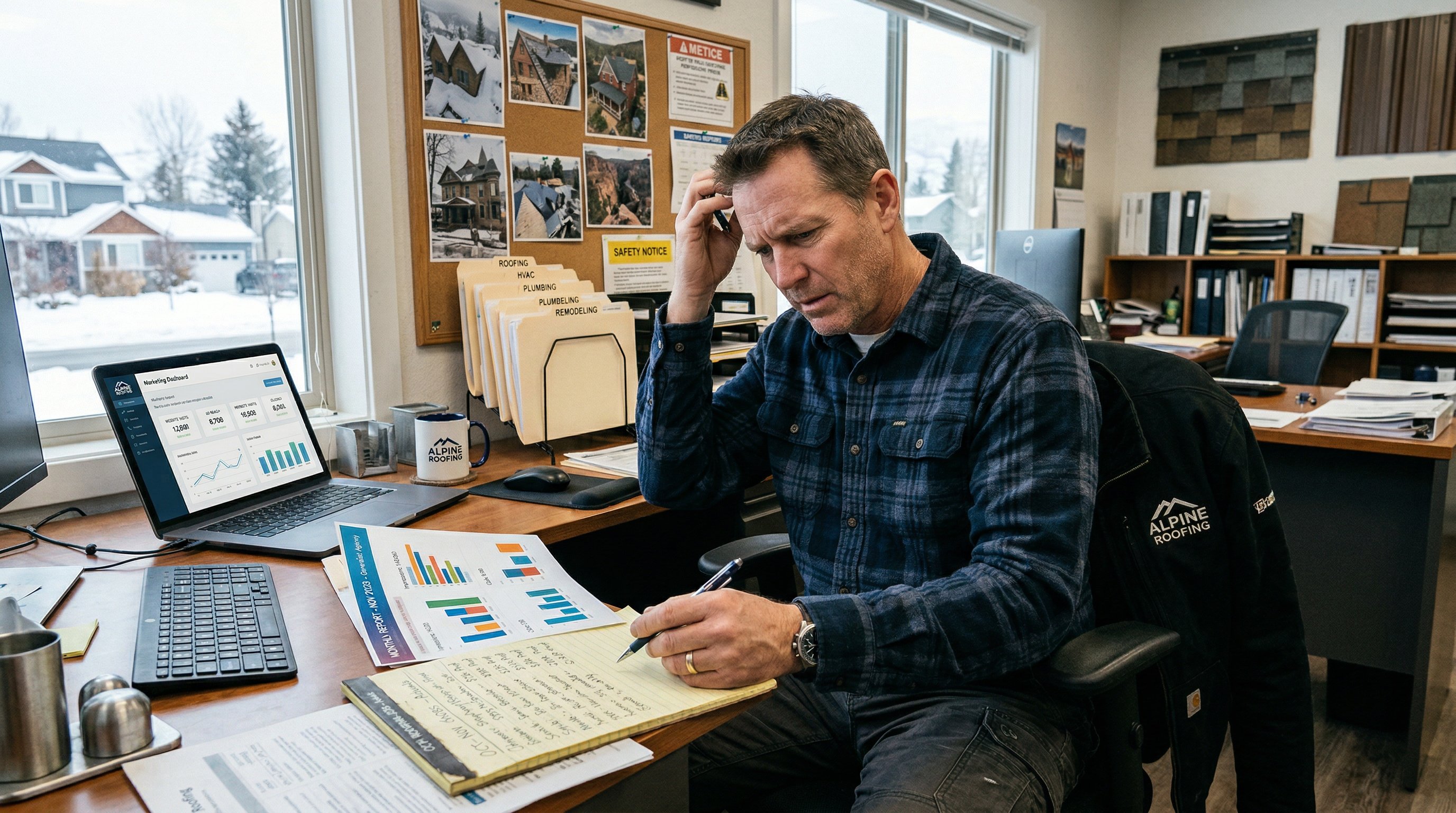
Generalist agencies usually understand marketing in the abstract. What they often miss is contractor economics.
A roofer doesn't need the same strategy as a downtown Salt Lake med spa. An HVAC company trying to land full-system replacements in Daybreak shouldn't be optimized for low-intent maintenance traffic. A remodeler selling $50,000 to $100,000 basement finishes in South Jordan can't rely on broad, bargain-hunter messaging.
This is where underperformance starts. The agency reports clicks, impressions, and cost per lead, but the contractor is still asking a simple question: Are these jobs worth running?
Trade-specific nuance matters deeply in our local market. In Utah, for example, a campaign for Park City roofing should speak to snow loads, canyon winds, ice dams, and premium engineered solutions. Historic neighborhoods like the Avenues or Sugar House call for messaging around restoration expertise and strict permit awareness. A generalist agency may never think that way.
And when an agency works with multiple competing contractors in the same market, lead quality usually gets even worse. Shared strategy often turns into shared outcomes.
The Core Services A Contractor-Focused Marketing Agency Should Offer
A contractor-focused marketing agency should offer a tight service stack built around lead quality and local dominance.
First, hyper-local SEO. Your Google Business Profile, service pages, reviews, and map pack visibility should be strong enough that you become the first call from Ogden to Provo.
Second, micro-targeted paid ads. Search and paid social campaigns should focus on high-intent homeowners in the exact neighborhoods you serve, 24/7. That's especially important for emergency HVAC, storm roofing, plumbing, solar, landscaping, basements, and concrete along the Wasatch Front.
Third, conversion infrastructure. Good traffic means nothing if your landing pages are weak or your forms are clunky. Strong agencies improve calls, forms, booking rates, and speed to lead with tools like instant SMS follow-up.
Fourth, content that builds trust. High-production video, clean project galleries of local Wasatch Front homes, and strong before-and-after proof help homeowners feel comfortable inviting your team into their home.
And finally, reporting should track booked estimates and revenue trends, not just ad spend and clicks.
How To Evaluate Lead Quality, Territory Strategy, And ROI Before You Sign
Before signing with any marketing agency, we recommend asking better questions than "How many leads can you get us?" Quantity alone is a trap.
Lead quality
Ask how the agency defines a qualified lead. Is it exclusive? Is it in your specific Utah service area? Is the homeowner asking for the service you actually want to sell? If you specialize in high-ticket replacements or renovations, the agency should be able to target for that.
Territory strategy
Ask whether they protect your market. This is a huge differentiator. At Midas Media, for example, the one-partner-per-market model means we don't generate leads for your direct local competitor in the same territory. That matters. If you're paying to build brand authority in Lehi, Sandy, Provo, or Park City, you shouldn't be funding someone else's pipeline too.
ROI expectations
Ask for realistic benchmarks: cost per booked estimate, close-rate assumptions, and expected payback period. Serious agencies talk in pipeline math. They should also be willing to stand behind performance. A strong guarantee, like working for free until lead targets are met, shows real skin in the game.
Red Flags To Watch For When Comparing Marketing Agencies
Some red flags are obvious. Others hide behind polished sales decks.
Watch out for agencies that talk constantly about impressions, reach, and brand awareness but stay vague on booked jobs. Those metrics have their place, but contractors stay in business on revenue, not dashboards.
Another warning sign: shared leads or aggregator-style sourcing. If your inquiries are being sold to multiple local contractors, you're not buying a growth system, you're buying a race to the bottom.
Be cautious if the agency can't explain your trade in plain English. If they don't understand the difference between tune-ups and replacements, patch jobs and full reroofs, or decorative concrete and structural flatwork, they probably can't target profitably.
Also ask who owns the assets. If they control your ad accounts, landing pages, tracking data, and call recordings with zero transparency, that's risky.
And if every market gets the same templated strategy, expect average results. Contractor marketing works best when it reflects local Wasatch Front demand, local neighborhoods, and local buyer psychology.
What A Strong Agency Partnership Looks Like Month To Month
A strong agency partnership should feel like operational support, not outsourced guesswork.
Month to month, there should be clear visibility into lead volume, lead quality, response times, booked estimates, and what's being adjusted. Good agencies don't "set and forget" campaigns. They refine targeting, shift budget toward better services, test messaging, and improve conversion points as data comes in.
We also think accountability should run both ways. The agency should bring leads. The contractor should follow up fast, track outcomes, and give real feedback from the field. If your sales team says a certain Utah County zip code produces better jobs, that insight should shape campaign strategy.
The best partnerships usually include territory clarity, exclusive lead handling, and a shared growth plan. That's the appeal behind Midas Media's model: one partner per market, direct-to-consumer lead generation, and a baseline goal of 50+ exclusive leads per month, with many partners scaling higher once the system matures.
That's not fluff. It's a working growth relationship.
Conclusion
Choosing a marketing agency in 2026 isn't really about choosing who can run ads. It's about choosing who can help you own your market along the Wasatch Front, attract better jobs, and stop depending on shared-lead platforms. For high-ticket contractors, the best partner is the one that understands your trade, protects your territory, and ties its success to your booked estimates, not vanity metrics.