 midas media.

If you run a roofing, HVAC, plumbing, solar, landscaping, concrete, electrical, flooring, or remodeling company, lead generation for my business usually means one thing: how do we get better jobs without wasting money on junk leads? In 2026, the answer isn't more random clicks. It's building a local system that attracts homeowners with real intent, converts them quickly, and follows up hard enough to win the estimate. For high-ticket home service businesses, the best lead generation strategy is part marketing, part sales process, and part speed. When those pieces work together, growth gets a lot more predictable.
What Lead Generation Means For High-Ticket Home Service Businesses
For high-ticket contractors, a lead is not just a form fill. It's a homeowner with a costly problem, a serious project, or an urgent replacement need. That distinction matters. A roofing company wants storm damage and premium replacement leads, not bargain shoppers. An HVAC contractor wants system replacement calls, not only low-margin tune-ups. A concrete or basement company wants larger-scope projects that can turn into $50,000 to $100,000 jobs.
So when we talk about lead generation for my business, we're really talking about qualified demand. The goal is to create a steady flow of local homeowners who fit our service area, budget, and job type.
That's also why exclusive leads outperform shared-lead platforms. If five contractors get the same lead, price becomes the conversation. If the lead comes directly to us, trust, speed, and expertise can win the job. That direct-to-consumer model is a big reason firms like Midas Media emphasize exclusive territory protection and booked estimates over vanity metrics.
How To Identify The Best Lead Sources For Your Service Area
Not every channel works the same in every market. The best lead sources depend on trade, geography, seasonality, and homeowner behavior.
Start with high-intent search traffic. Google Business Profile, local SEO, and paid search are usually the strongest sources because they capture people already looking for help. If a furnace dies in January or a roof leaks after wind and snow, homeowners don't browse casually. They search now.
Next, look at service-area nuances. In Utah, for example, messaging should change by zip code. Park City roofing demand may center on snow loads, ice dams, and wind-rated systems. In Daybreak or South Jordan, landscaping campaigns may need HOA-friendly design language. In Eagle Mountain or Saratoga Springs, concrete and drainage concerns can be central to the sale.
Then test supporting channels: Local Services Ads, retargeting, review generation, and video content. The rule is simple: choose lead sources that produce booked estimates and revenue, not just impressions or cheap clicks.
Build A Local Marketing Funnel That Turns Clicks Into Booked Jobs
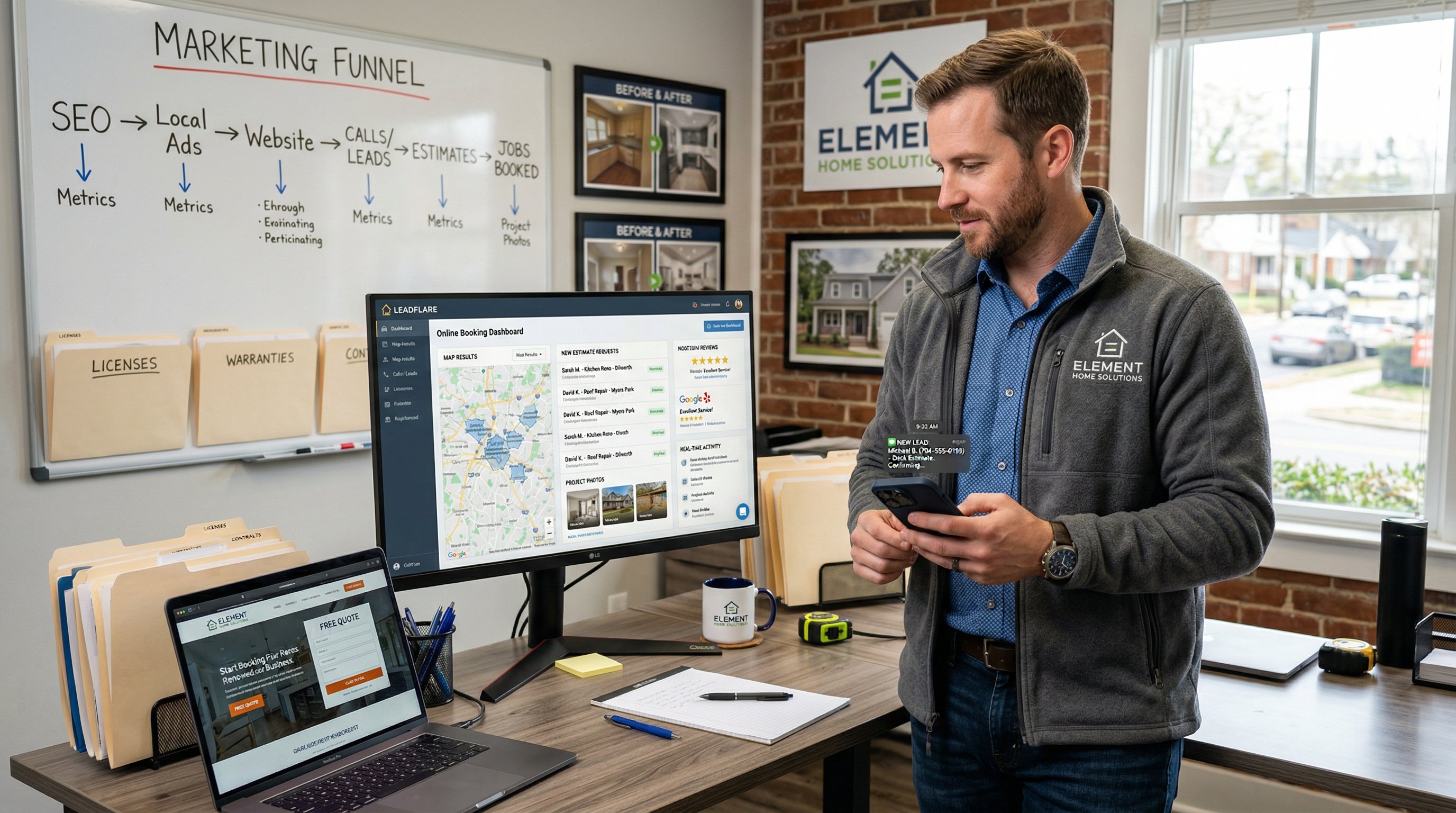
A local funnel should be built backward from the booked appointment.
First, attract the right homeowner with micro-targeted ads, local SEO, map pack visibility, and service pages tied to specific cities and job types. "HVAC replacement in Lehi" or "unfinished basement contractor in Utah County" will usually convert better than generic messaging.
Second, make the next step easy. That means click-to-call buttons, short forms, online booking, and instant SMS responses. Speed-to-lead is huge in 2026. If we wait 20 minutes, another contractor often gets the call.
Third, create trust fast. Show reviews, project photos, financing options, licenses, warranties, and real team video. Homeowners are inviting us into their homes: they want proof we're legit.
Finally, route every lead into a follow-up system. The funnel is not complete when the phone rings. It's complete when an estimate is booked and confirmed. That's the difference between marketing activity and actual lead generation for my business.
The Website Elements That Help Convert More Service Leads
Most contractor websites lose leads for boring reasons: slow load times, weak headlines, confusing navigation, and no clear call to action.
A strong lead-generation website needs a few essentials:
- Location-specific service pages for each core service and city
- Prominent phone number and sticky call buttons on mobile
- Fast quote forms that ask only what sales needs right now
- Social proof like reviews, badges, case studies, and before-and-after photos
- Trust builders such as financing, guarantees, and warranty language
- Clear differentiation explaining why homeowners should choose us
For higher-ticket trades, visual proof matters more than many owners realize. Professional video, clean project galleries, and even crew footage can raise conversion rates because they reduce risk in the homeowner's mind.
And don't ignore local SEO signals. A well-optimized Google Business Profile, matching NAP data, schema markup, and city relevance all help turn the website into a stronger conversion asset, not just an online brochure.
How To Qualify, Track, And Follow Up With Every Lead
A lot of contractors think they have a lead problem when they really have a follow-up problem.
We need to qualify every inquiry quickly. Ask: Is it in our service area? Is it the right service? Is there urgency? Is this a repair, replacement, or full project? A short intake script can save hours and improve close rates.
Next, track the source. Every lead should be tied to a channel, campaign, and outcome. If we can't see which ads, keywords, or pages produced booked jobs, we can't scale intelligently.
Follow-up should be immediate and persistent. Best practice in 2026 looks like this:
- Instant text acknowledgment
- Fast call-back, ideally within minutes
- Email confirmation with next steps
- Appointment reminders
- Re-engagement for no-shows and unclosed estimates
This is where automation helps. Midas Media's AI-powered speed-to-lead approach reflects what the market now expects: homeowners want digital-first communication, especially when contractors are out in the field. The faster and cleaner the response, the more revenue each lead can produce.
Common Lead Generation Mistakes That Waste Budget And Slow Growth
The biggest mistake is chasing volume instead of fit. Cheap leads are expensive when they waste dispatch time, sales time, and ad budget.
Other common problems include:
- Buying shared leads from aggregators where everyone competes on price
- Running broad campaigns with no city, service, or project-type targeting
- Sending traffic to a homepage instead of a relevant service page
- Responding too slowly to calls and forms
- Failing to track booked estimates and closed revenue
- Ignoring reviews and Google Business Profile optimization
Another quiet killer is weak positioning. If our message sounds like every other contractor, homeowners compare us only on price. But if we emphasize specialized value, like historic restoration in Sugar House, HOA-compliant landscaping in South Jordan, or wind-rated roofing in Park City, we create room for premium pricing.
And one more thing: don't judge success by clicks alone. Real success is booked estimates, profitable jobs, and a pipeline we can rely on month after month.
Conclusion
Lead generation for my business works best when we stop treating it like a single tactic and start treating it like a system. The right local traffic, a high-converting website, fast follow-up, and clear tracking all matter. For home service contractors, predictable growth comes from exclusive, high-intent leads and a process built to turn interest into booked jobs.