 midas media.
Most contractors don't have a lead problem. They have a territory problem. They're showing up too broadly, paying for clicks from homeowners they'll never serve, or blending into the same map pack as everyone else. In 2026, hyper-local contractor marketing is about tightening the radius and increasing the relevance. When we align your service area, search visibility, reviews, ads, and follow-up around the exact cities, ZIP codes, and neighborhoods that produce your best jobs, marketing gets more efficient fast. And for high-ticket home service businesses, that usually means better margins, better close rates, and fewer wasted leads.
What Hyper-Local Contractor Marketing Really Means For Home Service Businesses
Hyper-local contractor marketing means we stop thinking in terms of a whole metro and start thinking like a homeowner with an urgent problem. People don't search for "best roofer in Utah." They search for "roof repair Sandy UT," "AC replacement Lehi," or "electrician near Sugar House." That difference matters.
For home service businesses, hyper-local marketing focuses on the areas where crews can get there quickly, average job values are strong, and competition can be beaten. It's not just local SEO. It's the full system: local landing pages, Google Business Profile signals, service-area ad targeting, neighborhood-specific messaging, reviews from nearby customers, and fast response tools that turn searchers into booked estimates.
This is especially important for high-ticket trades. A basement finishing campaign in Vineyard should not sound like a roofing campaign in Park City after a snowstorm. The closer the message matches the local need, the higher the trust. That's why firms like Midas Media build exclusive, territory-based lead systems instead of broad, shared-lead campaigns that leave contractors fighting over the same prospect.
How To Define Your Most Profitable Service Area By City, ZIP Code, And Neighborhood
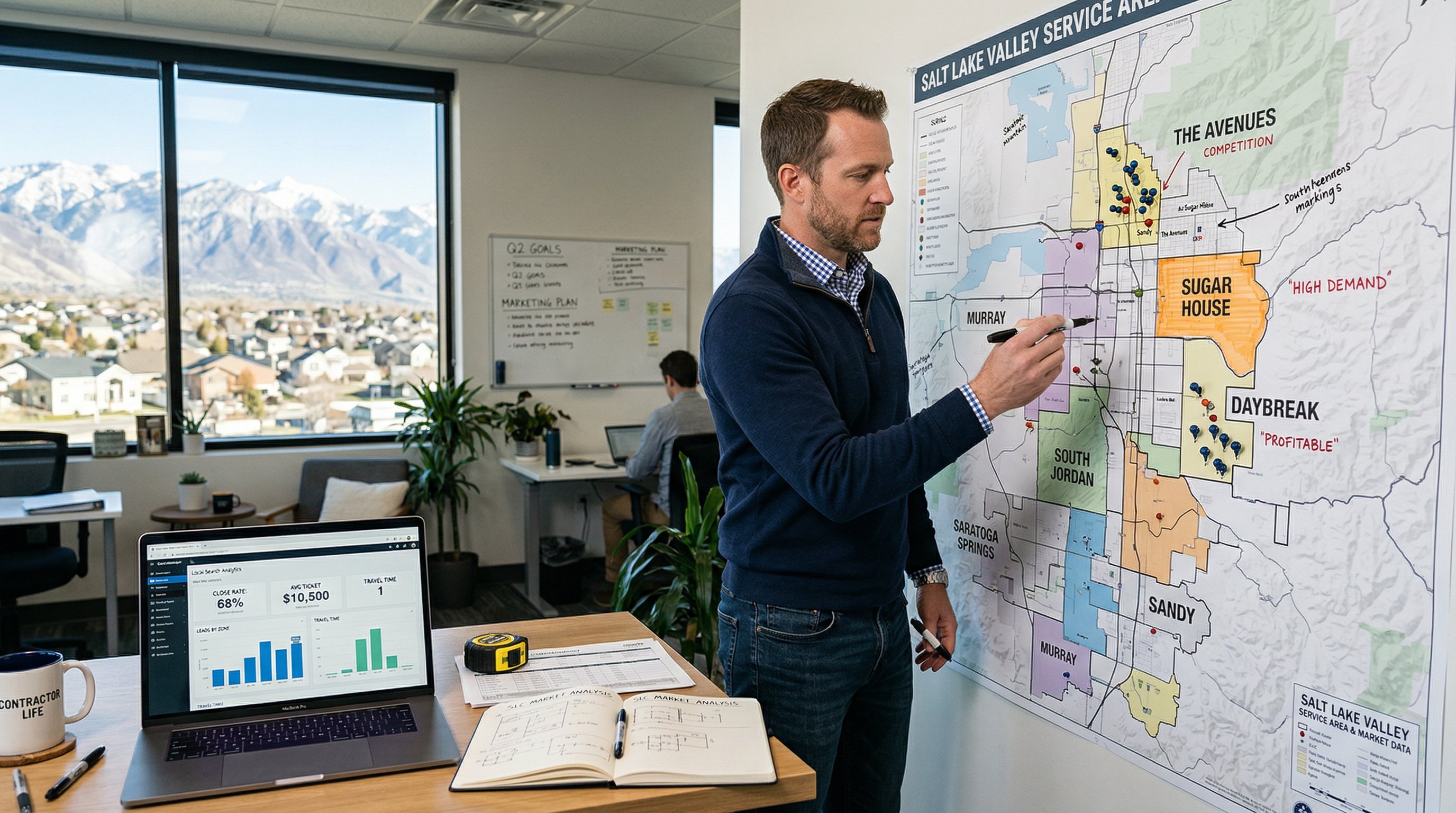
The smartest service area isn't always the biggest one. We define profitable territory by looking at four things: close rate, average ticket, travel efficiency, and local demand. If one ZIP code produces larger remodeling jobs and fewer tire-kickers, that's worth more than a wider radius full of low-intent leads.
Start by reviewing your last 25 to 50 sold jobs. Which cities produced the best margins? Which neighborhoods had the shortest drive times and the least friction? Then layer in search behavior. Emergency plumbing terms may surge in dense older neighborhoods, while landscaping and solar searches often cluster in higher-income growth areas.
In Utah, local nuance is everything. Daybreak and South Jordan respond to clean job-site promises and HOA-friendly messaging. The Avenues and Sugar House care about historic restoration and permit familiarity. Saratoga Springs and Eagle Mountain often need drainage, structural, and finishing solutions tied to rapid development. When we segment by neighborhood instead of treating the market like one blob, we usually uncover the real growth pockets.
Build A Local Presence That Converts Searchers Into Calls
If your digital presence feels generic, local homeowners won't assume you're the obvious choice. They'll keep scrolling. A strong hyper-local presence signals three things immediately: we serve your area, we understand your type of project, and we're easy to contact right now.
That means every major service should be paired with location relevance. Your site needs focused city or neighborhood pages, clear service-area language, local proof, and friction-free conversion paths. Phone numbers should be click-to-call. Forms should be short. And response speed can't lag, especially in HVAC, plumbing, roofing, and electrical where intent spikes fast.
In practice, this is where many contractors lose money. They invest in traffic but not in conversion infrastructure. We've seen instant SMS follow-up and automated booking dramatically improve lead capture, especially when owners are in the field and can't answer every call. In 2026, speed to lead isn't a nice extra. It's part of your local marketing performance.
Optimize Your Google Business Profile, Service Pages, And Local Trust Signals
Your Google Business Profile is still one of the highest-leverage assets in hyper-local contractor marketing. It needs accurate categories, real service areas, fresh photos, regular posts, and review velocity. But that alone won't carry the load.
Your service pages should mention actual city and neighborhood use cases naturally, not through clunky keyword stuffing. A roofer can speak to wind-rated systems in Park City or storm response in Sandy. A concrete contractor can highlight basement and flatwork demand in Utah County growth corridors. Specificity converts.
Then add trust signals that make the local choice feel safe: licensed and insured badges, financing info, warranty language, local association memberships, before-and-after galleries, and testimonials tied to real communities. If you can show that you've solved the exact problem for someone nearby, calls go up. Searchers don't just want a contractor. They want one who already understands their street, their home type, and their expectations.
Use Reviews, Photos, And Community Proof To Stand Out In A Crowded Market
When multiple contractors look similar online, proof breaks the tie. Reviews are the obvious piece, but not all reviews carry the same weight. The best ones mention the service, city, and outcome: fast AC replacement in Orem, clean reroof in Draper, responsive emergency plumber in Riverton. Those details help both rankings and conversions.
Photos matter just as much. Homeowners want to see your trucks, your crew, your finished work, and yes, your job-site cleanliness. For premium trades, polished media can justify premium pricing. Video is even better because it builds familiarity before the first call. A short walkthrough of a remodel in Sugar House or a concrete project in Lehi can do more than a paragraph of sales copy.
Community proof also includes sponsorships, neighborhood involvement, and recognizable project locations. We're not talking about fake "local vibes." We mean real evidence that you work here and understand the market. That's one reason Midas Media leans so hard into Utah-specific positioning and one-partner-per-market territory protection: exclusivity only works when credibility is visible.
Run Hyper-Targeted Ads Without Wasting Budget Outside Your Territory
Paid ads can scale fast, but they can also burn cash fast if targeting is sloppy. Hyper-targeted ads start with geographic discipline. We don't just target a county and hope for the best. We narrow by city clusters, ZIP codes, income fit, service intent, and in some cases even weather triggers or seasonal demand.
For example, a roofing campaign can intensify after high winds or winter storm events. HVAC ads should prioritize emergency replacement intent, not just low-value tune-up searches. Landscaping and solar campaigns often perform best with messaging tied to outdoor living ROI and long-term savings in higher-value neighborhoods.
Just as important is exclusion. If you won't drive there, don't pay for impressions there. Build negative location lists, tighten radius settings, and monitor search term reports weekly. Then connect ads to matching local landing pages, not a generic homepage.
For contractors who want predictable growth, exclusive territory models are powerful because they remove internal competition. Midas Media's one-partner-per-market approach is built around that principle: all leads from the protected area belong to one contractor.
Conclusion
Hyper-local contractor marketing works because it matches how homeowners actually buy: nearby, urgently, and based on trust. When we define the right territory, build visible local proof, and target only the areas that produce profitable jobs, marketing gets sharper. The goal isn't to be everywhere. It's to own your exact service area, and become the first call when the work is high value.