 midas media.
Most HVAC companies don't have a lead problem. They have a strategy problem. Too much money goes into broad campaigns, low-value tune-up traffic, or shared-lead platforms that turn every job into a price war. In 2026, the better play is tighter targeting, faster follow-up, and a marketing system built around high-intent local demand. We've seen the biggest gains come from a simple shift: stop chasing "more clicks" and start engineering better jobs. Here's the HVAC marketing strategy we'd use to generate stronger local leads, improve booking rates, and create predictable growth.
Define Your Ideal HVAC Customer And Service Mix Before You Market
Before we touch SEO, ads, or automation, we need clarity on who we actually want.
For most HVAC contractors, not all leads are equally valuable. Emergency no-cool calls, furnace replacements, heat pump installs, ductwork, and IAQ upgrades usually produce much better economics than bargain-hunter maintenance requests. If we market everything to everyone, we usually attract the lowest-intent traffic.
Start with two filters:
- Best customer type: homeowner, property manager, builder, or light commercial
- Best service mix: repair, replacement, financing-driven installs, maintenance, or add-ons
Then layer in geography. A strong HVAC marketing strategy should reflect local conditions, housing stock, and income levels by zip code. New-build areas may respond to indoor air quality and zoning upgrades: older neighborhoods may need full system replacements and duct remediation.
This is also where positioning matters. We should know whether we're competing on speed, trust, premium expertise, financing, or same-day availability, not generic "quality service."
Build A Local Lead Generation Foundation With SEO, Google Business Profile, And Local Service Ads
Local search is still the backbone of HVAC lead generation because urgency drives behavior. When an AC dies in July, homeowners search fast, compare quickly, and call whoever looks most credible.
That means our foundation has three parts.
First, local SEO: city pages, service pages, and content built around real buying intent like "AC replacement," "furnace repair," or "heat pump installation" in specific markets.
Second, Google Business Profile: strong categories, fresh photos, service areas, review velocity, and consistent updates. If we're not showing up in the map pack, we're missing some of the highest-intent traffic available.
Third, Local Service Ads: they can work especially well for HVAC when call handling is tight and service windows are clear.
For contractors in competitive markets, this is where hyper-local execution matters. At Midas Media, that often means micro-targeting by service area rather than treating an entire metro the same. Search behavior in Lehi, Sandy, or Park City won't always convert the same way.
Turn Your Website Into A Conversion Tool That Books Calls, Estimates, And Financing Leads
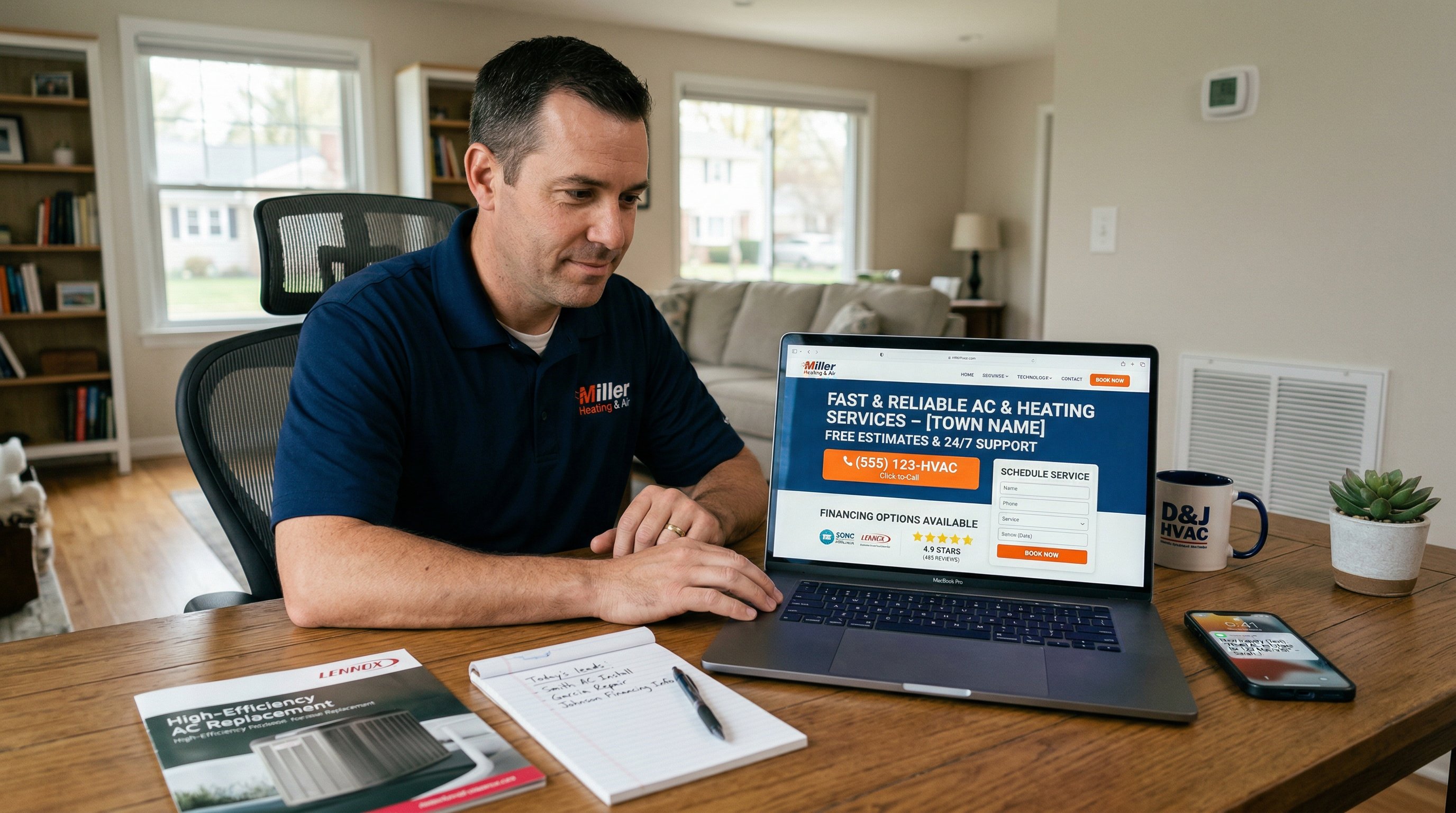
A lot of HVAC websites look decent but convert poorly. They explain the company without helping the customer take the next step.
Your site should answer three questions in under five seconds:
- What do you do?
- Where do you work?
- Why should someone contact you now?
That means clear service headlines, click-to-call buttons, fast mobile load times, financing visibility, trust signals, and simple forms. Emergency traffic needs speed. Replacement traffic needs reassurance. Both need a frictionless path to book.
We also want conversion elements that match real homeowner behavior:
- Financing callouts for higher-ticket replacements
- Online booking or instant SMS response for after-hours leads
- Review proof near forms and phone numbers
- Offer framing that supports premium service without sounding gimmicky
And don't bury your best jobs. If replacements and high-efficiency installs drive revenue, those pages should be more prominent than generic maintenance content.
Use Paid Advertising Strategically To Capture High-Intent Demand Without Wasting Budget
Paid ads work well in HVAC, but only when they're structured around intent. Too many contractors burn budget on broad match traffic, weak landing pages, or campaigns that mix repairs, tune-ups, and replacements into one bucket.
We'd separate campaigns by service type and urgency. Emergency repair searches should not be handled the same way as system replacement or ductless installation. They have different economics, different conversion paths, and different messaging.
A strong paid approach in 2026 usually includes:
- Search ads for bottom-funnel service terms
- Remarketing for estimate follow-up
- Seasonal budget shifts around peak heating and cooling demand
- Zip-code level targeting where close rates and ticket values are strongest
The goal isn't just more leads. It's more profitable leads.
That's also why many contractors are moving away from shared-lead marketplaces. Exclusive, direct-to-contractor campaigns typically produce better close rates because the homeowner calls one company, not five. That principle is central to how Midas Media approaches territory protection and lead generation.
Create Follow-Up Systems For Missed Calls, Unsold Estimates, And Off-Season Opportunities
This is where a surprising amount of revenue leaks out.
If you miss calls after hours, fail to re-engage unsold estimates, or go quiet in shoulder seasons, you're leaving booked jobs on the table. HVAC marketing strategy isn't only about lead generation: it's also about lead recovery.
We recommend three simple systems.
First, missed-call text back. If the office doesn't answer, the prospect should get an immediate message with a booking option.
Second, estimate follow-up automation. Not aggressive spam, just smart reminders, testimonial proof, financing prompts, and seasonal urgency.
Third, off-season reactivation. Spring and fall are ideal for nurturing maintenance customers into IAQ upgrades, duct cleaning, smart thermostats, or early replacement planning.
The fastest-growing contractors usually win on speed to lead. Homeowners increasingly expect digital-first communication, especially when they're busy, at work, or browsing after hours. A tight SMS and scheduling workflow can outperform a bigger ad budget.
Track The Metrics That Actually Matter: Cost Per Lead, Booking Rate, And Revenue By Channel
A campaign can look great on paper and still produce weak business results. Clicks, impressions, and traffic are useful diagnostics, but they're not the scoreboard.
We want to track metrics that connect marketing to revenue:
- Cost per lead by channel
- Booking rate from lead to scheduled call or estimate
- Show rate for appointments
- Close rate by service type
- Average ticket and revenue by channel
This matters because not all lead sources behave the same. Google Business Profile leads may close differently than paid search. Local Service Ads may generate more calls but lower average tickets. SEO may take longer to ramp but produce stronger long-term ROI.
Once we see those patterns, we can make better decisions. We stop funding channels that create noise and double down on those that produce profitable work.
For high-ticket home service contractors, that's the real goal: not vanity metrics, not generic "brand awareness," but booked estimates and revenue you can trace back to the source.
Conclusion
The best HVAC marketing strategy in 2026 is more disciplined than flashy. We define the right customer, dominate local intent, convert traffic efficiently, follow up fast, and measure what actually drives revenue. Do that consistently, and marketing stops feeling random. It becomes a system, one that fills the calendar with better jobs, not just more inquiries.